


Why verification becomes expensive
An answer can contain many checkable claims. Re-running expensive inference for every claim–evidence pair becomes costly as both grow. E-Verify addresses verification when relevant evidence has already been supplied.
From text inference to representation interaction
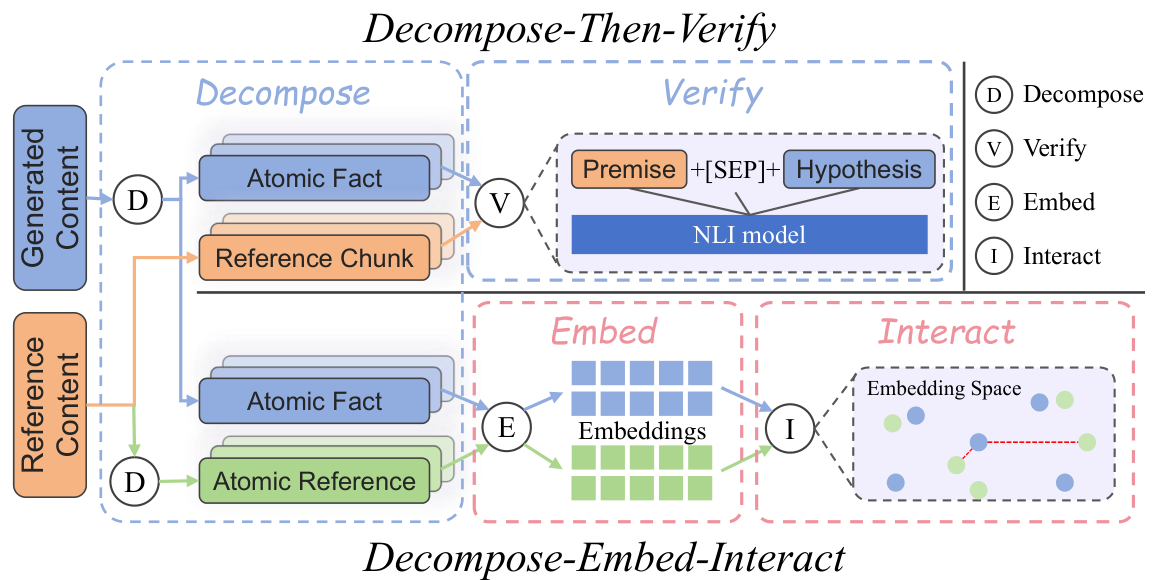
Its decompose–embed–interact pipeline splits content into fine-grained facts, encodes them into verification-oriented representations and performs interactions in embedding space. The goal is evidence support, rather than ordinary topical similarity.
What the paper demonstrates
Dedicated modules address decomposition, fact-sensitive representations and embedding-space verification. The reported experiments improve decomposition and verification efficiency while retaining competitive accuracy.
Understanding the scope
This does not establish that input sources are reliable or replace open-web investigation. A deployed workflow still needs source selection, retrieval and review so that judgments can be traced to their evidence.
Paper and resources
E-Verify: A Paradigm Shift to Scalable Embedding-based Factuality Verification
This overview introduces the work; consult the paper for complete methods and experimental settings.