


Similarity is not support
Two sentences can share a topic while differing in a number, entity or condition. Shared context may dominate similarity scores, whereas evidence support is directional.
Retaining differences, filtering background
GRD separately encodes evidence and claims into multiple semantic slots. Directional and magnitude residuals describe their differences; adaptive gating filters background noise before aggregation. Evidence representations can be cached.
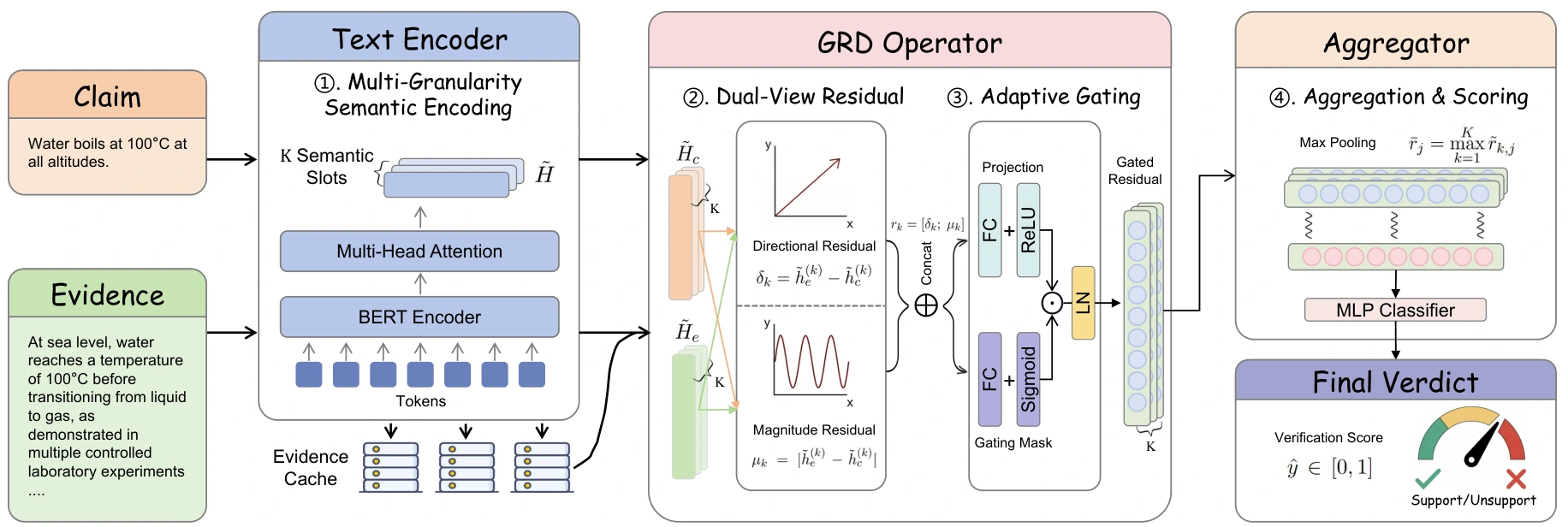
Reading the efficiency result
Across the reported benchmarks, average Macro-F1 is 79.99%, 1.15 points below the strongest cross-encoder baseline, with a 23.55× speedup. These are experimental comparisons, not deployment guarantees.
Where it fits
Repeated checks against shared evidence are a natural application. Task-specific validation should inspect numbers, negation and qualifiers, alongside aggregate scores.
Paper and resources
Gated Residual Discrepancy for Efficient Bi-Encoder Factuality Verification
This overview introduces the work; consult the paper for complete methods and experimental settings.